
Last updated:
How to Talk to Your Partner About Painful Sex: A Compassionate Guide
Practical conversation starters and strategies for discussing painful intercourse with your partner. Learn how to communicate openly, build support, and redefine intimacy together.

Medical disclaimer: This article is for informational purposes only and does not constitute medical advice. If you are experiencing painful intercourse, please consult a qualified healthcare professional for personalised diagnosis and treatment. See our guide on when to see a doctor for more information.
Painful sex — medically known as dyspareunia — is common, with persistent symptoms affecting roughly 10-20% of women in U.S. estimates [1]. Yet despite how common it is, many women carry the burden of this experience in silence, unsure how to tell their partner what is happening.
If you have been dreading this conversation, you are not alone. In couples coping with provoked vestibulodynia, healthier sexual communication patterns have been associated with better sexual and relational adjustment [2]. Talking about painful sex is not a sign of failure — it is a practical first step toward healing, together.
Why Does Communicating About Painful Sex Matter?
When pain during intimacy goes unspoken, it rarely stays contained. It tends to ripple outward — creating avoidance patterns, emotional distance, and misunderstandings that can erode even the strongest relationships.
For the person experiencing pain, silence often leads to:
- Enduring pain to avoid disappointing a partner
- Developing anxiety or dread around intimacy
- Feeling isolated, ashamed, or “broken”
- Avoiding physical closeness entirely
For the partner, not knowing can lead to:
- Confusion about why intimacy has decreased
- Fear that they are doing something wrong
- Feelings of rejection or inadequacy
- Frustration that can be misdirected
Research in couples dealing with provoked vestibulodynia suggests that how partners communicate about pain matters to both sexual wellbeing and relationship adjustment [2]. In other words, the conversation itself can be part of the solution.
How Should You Prepare for the Conversation?
Bringing up painful sex does not have to be a dramatic revelation. A little preparation can make the discussion feel safer and more productive for both of you.
Choose the right moment
Avoid raising the topic during or immediately after a sexual encounter, when emotions are heightened. Instead, choose a calm, private moment — perhaps during a walk, over a quiet meal, or while sitting together at home. The goal is a low-pressure environment where neither of you feels cornered.
Clarify what you want to communicate
Before you speak, it helps to reflect on what you want your partner to understand. Consider writing down:
- What you are experiencing — the physical sensations, when they occur, how long this has been happening
- How it makes you feel emotionally — anxious, frustrated, sad, disconnected
- What you need from your partner — patience, reassurance, willingness to explore alternatives
- What you are already doing about it — or what you would like to do together
Use “I” statements
Framing the conversation around your own experience reduces the chance of your partner feeling blamed or defensive. Compare:
- “You always hurt me during sex” vs. “I’ve been experiencing pain during intercourse, and I want us to work through it together”
- “You don’t care about how I feel” vs. “I feel anxious about intimacy right now, and I need your support”
What Are Good Conversation Starters?
Finding the first words is often the hardest part. Here are some openers that women and therapists have found effective:
- “I want to share something with you because I trust you and our relationship matters to me.”
- “I’ve been experiencing some physical discomfort during sex, and I think it’s important we talk about it.”
- “This isn’t about anything you’re doing wrong — my body has been responding in a way that’s causing me pain, and I’d like us to figure this out together.”
- “I’ve been doing some reading about a condition that might explain what I’ve been going through. Can I share what I’ve found?”
If speaking face to face feels overwhelming, it is perfectly valid to write a letter, send a message, or even share an article — like this one — as a starting point.
What Should You Avoid Saying?
Just as there are helpful ways to open the conversation, there are a few approaches worth steering clear of:
- Minimising your experience — Saying “it’s not a big deal” or “don’t worry about it” sends the message that your pain does not matter. It does.
- Blaming your partner — Even if certain actions contribute to discomfort, leading with blame shuts down productive dialogue.
- Apologising for your body — You do not owe anyone an apology for experiencing pain. Phrases like “I’m sorry I’m broken” reinforce shame rather than promote healing.
- Making ultimatums — “If you can’t handle this, then…” creates pressure rather than partnership.
- Assuming your partner’s reaction — You might be surprised by how compassionate and willing to adapt your partner is. Give them the chance to show up for you.
How Can Partners Be Supportive?
If you are reading this as the partner of someone experiencing painful sex, your role is more important than you might realise. Studies in provoked vestibulodynia show that partner responses are associated with pain and sexual satisfaction: more facilitative responses are linked with lower pain and better sexual satisfaction, while overly solicitous responses can be associated with worse pain outcomes [3].
Here is how you can help:
Listen without trying to fix
Your first instinct may be to solve the problem. Resist it — at least initially. What your partner needs most is to feel heard and believed. Validate their experience: “Thank you for telling me. I’m glad you trust me with this.”
Educate yourself
Take the initiative to learn about your partner’s condition. Understanding what vaginismus or vulvodynia actually involves — the involuntary muscle responses, the neurological components — can transform your perspective from “what am I doing wrong?” to “how can we navigate this together?”
Be patient with the process
Recovery from painful sex conditions is rarely linear. There will be good days and setbacks. Avoid putting pressure on timelines or milestones. If your partner is using dilator therapy, understand that progress happens gradually and at their pace.
Check in regularly
Do not let the conversation be a one-off. Create a culture of ongoing, gentle check-ins: “How are you feeling about things lately?” or “Is there anything you’d like to try differently?”
Manage your own emotions
It is natural to feel confused, worried, or even frustrated. These feelings are valid — but they are yours to process, ideally with a trusted friend, therapist, or support group, rather than placing them on your partner during a vulnerable moment.
How Can You Redefine Intimacy Beyond Penetration?
One of the most liberating shifts couples can make is expanding their definition of intimacy. Penetrative sex is only one form of physical connection — and when it causes pain, it should never be the measure of a relationship’s success.
Consider exploring:
- Sensate focus exercises — A structured technique developed by Masters and Johnson, where partners take turns touching each other in a non-goal-oriented way, gradually rebuilding comfort and pleasure without the pressure of penetration.
- Massage and skin-to-skin contact — Physical closeness that reinforces bonding and trust.
- Oral intimacy and manual stimulation — Pleasurable alternatives that do not involve penetration.
- Emotional intimacy practices — Shared vulnerability, deep conversation, eye contact exercises, and expressions of gratitude.
- Parallel self-care — Supporting each other’s individual healing journeys, including pelvic floor exercises and relaxation techniques.
Redefining intimacy is not “settling” — it is choosing connection over performance, and prioritising pleasure and safety for both partners.
When Should You Consider Couples Therapy?
While many couples navigate this journey with open communication and mutual patience, there are times when professional support makes a meaningful difference. Consider seeking a couples therapist or sex therapist if:
- Conversations about sex consistently lead to conflict or withdrawal
- One or both partners feel resentment building
- There is a significant mismatch in expectations around intimacy
- Past trauma (for either partner) is influencing the dynamic
- You feel stuck despite your best efforts to communicate
A qualified sex therapist can provide structured frameworks for communication, address underlying psychological factors, and guide you through exercises designed to rebuild intimacy safely. Many pelvic floor physiotherapists also work alongside therapists to provide a holistic treatment approach — see our guide on navigating menopause and intimate health for an example of how multidisciplinary care works.
Look for practitioners certified by recognised bodies such as COSRT (College of Sexual and Relationship Therapists) in the UK, or AASECT (American Association of Sexuality Educators, Counselors and Therapists) internationally.
What Does It Look Like From the Partner’s Perspective?
Partners of people experiencing painful sex often describe a complex mix of emotions: concern, helplessness, guilt, and sometimes a quiet grief for the intimate life they envisioned. These feelings are understandable — and they deserve space too.
Common experiences partners report include:
- Self-blame — “Am I causing this?” In the vast majority of cases, the answer is no. Conditions like vaginismus involve involuntary muscle responses that are not caused by a partner’s actions.
- Fear of initiating — Partners may withdraw from all physical contact, worried about causing pain. This can inadvertently increase emotional distance.
- Feeling excluded from the solution — If treatment is framed as solely the affected person’s responsibility, partners can feel sidelined.
The healthiest dynamic is one where both partners see themselves as a team. That might mean attending a physiotherapy appointment together, learning about dilator therapy timelines, or simply holding space for honest conversation on difficult days.
Moving Forward Together
Talking to your partner about painful sex takes courage — and it is one of the most important steps you can take, both for your health and for your relationship. Couple-based research suggests that open, supportive communication helps partners adapt, protect intimacy, and navigate treatment more effectively [2][3].
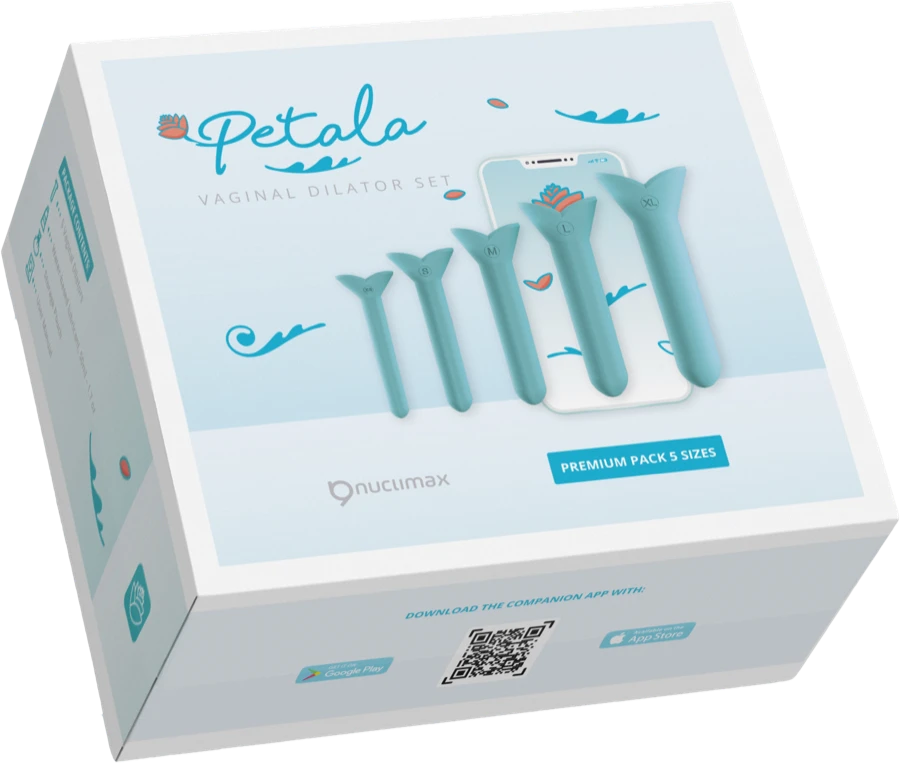
If you are beginning or continuing your recovery journey, tools like the Petala 5-Pack Silicone Dilator Set can be a gentle, structured way to work through physical discomfort at your own pace — ideally alongside professional guidance and the support of a partner who understands what you are going through.
You deserve both pleasure and partnership. The conversation is the beginning.
Frequently Asked Questions
How do I bring up painful sex if my partner gets defensive?
Start by framing the conversation as something you want to work on together, not as a criticism. Use “I” statements and emphasise that you are sharing this because you value the relationship. If defensiveness persists, a couples therapist can provide a neutral space for the discussion.
Should I tell my partner the specific diagnosis?
Sharing a diagnosis like vaginismus or vulvodynia can be very helpful — it gives your partner something concrete to understand and research. However, you are never obligated to share more than you are comfortable with. Share at your own pace.
What if my partner pressures me to have sex despite the pain?
A partner who respects you will never pressure you to endure pain for their pleasure. If you feel pressured, this is a serious concern that warrants a direct conversation and, if necessary, professional support. Your bodily autonomy is non-negotiable.
Can dilator therapy be something we do together?
Yes — many couples incorporate dilator therapy into their intimacy routine with positive results. This should always be led by the person using the dilators, and only when they feel ready. A good-quality silicone dilator set with a graduated size range, combined with a suitable lubricant, makes the process more comfortable.
How long does it take for things to improve?
Recovery timelines vary significantly depending on the underlying condition, treatment approach, and individual factors. Some couples notice improvements within weeks; for others, it takes several months. Patience, consistency, and open communication are the most reliable predictors of progress. Our dilator therapy timeline guide offers a more detailed breakdown.
References
[1] Hill, D. A., & Taylor, C. A. (2021). Dyspareunia in women. American Family Physician, 103(10), 597–604.
[2] Rancourt, K. M., Flynn, M., Bergeron, S., & Rosen, N. O. (2017). It takes two: Sexual communication patterns and the sexual and relational adjustment of couples coping with provoked vestibulodynia. The Journal of Sexual Medicine, 14(3), 434–443.
[3] Rosen, N. O., Bergeron, S., Glowacka, M., Delisle, I., & Baxter, M. L. (2012). Harmful or helpful: Perceived solicitous and facilitative partner responses are differentially associated with pain and sexual satisfaction in women with provoked vestibulodynia. The Journal of Sexual Medicine, 9(9), 2351–2360.
Ready to start your journey to pain-free intimacy?
Shop Petala 5-Pack