
Last updated:
How Long Does Dilator Therapy Take? Realistic Timelines and What to Expect
Understand how long dilator therapy takes, what the research says about realistic timelines, factors that influence duration, week-by-week expectations, and how to handle plateaus.

“How long will this take?” It’s one of the first questions women ask when they begin dilator therapy — and one of the hardest to answer with a single number. The honest truth is that timelines vary significantly from person to person. But that doesn’t mean you can’t set realistic expectations. This guide covers what the research says, what influences your individual timeline, what a typical week-by-week journey looks like, and how to navigate the plateaus that nearly everyone encounters.
Medical disclaimer: This article is for educational purposes only and does not constitute medical advice. Dilator therapy timelines are highly individual. Always work with a qualified healthcare professional — such as a pelvic floor physiotherapist or gynaecologist — to develop a treatment plan tailored to your specific needs.
What Does the Research Say About Dilator Therapy Duration?
Let’s start with the evidence. The most important point is that research does not support a single universal timeline.
The 2012 Cochrane review on vaginismus found limited evidence and advised caution when interpreting treatment efficacy [1]. More recent reviews and meta-analysis suggest that multimodal approaches can help, but published studies vary widely in diagnosis, treatment protocol, and outcome definition [2][4].
Some intensive specialist programmes move faster than home-based routines. In Pacik and Geletta’s 241-patient multimodal vaginismus cohort, women who reported pain-free intercourse did so at a mean of 5.1 weeks, but that programme also included Botox, sedation-assisted dilation, and close follow-up [3]. That is not the same as a typical home-only routine.
The takeaway: Think in terms of weeks to months, and sometimes longer. Progress depends heavily on your diagnosis, baseline pain, emotional response, consistency, and the kind of professional support you have around you.
What Factors Influence How Long Therapy Takes?
Understanding the variables that affect your timeline helps you set realistic expectations and reduces the frustration of comparing your progress to someone else’s.
The Underlying Condition
- Primary vaginismus (lifelong, present since first attempt at penetration) — often involves deeply ingrained muscle guarding patterns and psychological components. Timelines tend to be longer, typically 3–6+ months
- Secondary vaginismus (developed after a period of pain-free penetration) — progression is sometimes faster because the body has prior experience with comfortable penetration, though trauma or medical causes can complicate this
- Post-surgical or post-radiation recovery — timelines vary widely based on the extent of tissue changes and scarring
- Menopausal vaginal atrophy — may improve over weeks to months, especially when dryness and tissue changes are being treated alongside dilation
- Endometriosis-related pain — may require concurrent medical management alongside dilator therapy. See our guide on endometriosis and dilator therapy for more detail
Consistency of Practice
This is the single most controllable factor. Many clinical guides use schedules around 3 to 4 sessions per week, and consistency matters more than forcing a rigid calendar [5].
Psychological Factors
Anxiety, fear, past trauma, and the emotional weight of intimate pain all affect how quickly the pelvic floor learns to relax. Women who combine dilator therapy with cognitive-behavioural therapy (CBT) or work with a psychologist specialising in sexual health often progress faster — not because the physical work is different, but because the psychological barriers are being addressed simultaneously.
For a deeper understanding of the psychological dimensions of pelvic pain, our article on understanding vaginismus covers this in detail.
Starting Severity
A woman who can comfortably begin with a Size 2 dilator will naturally have a shorter journey to the final size than someone starting with a Size 1 (or someone who initially cannot insert even the smallest size without discomfort). This is not a reflection of effort or commitment — it’s simply a different starting point.
Pelvic Floor Muscle Condition
Women with significant pelvic floor hypertonicity (chronically tight muscles) may need more time for the muscles to learn a new resting state at each dilator size. Complementary pelvic floor exercises — particularly reverse Kegels and diaphragmatic breathing — can accelerate this process.
Support Systems
Having a supportive partner, an informed healthcare team, and access to community (whether online or in-person) correlates with better outcomes and faster progress. Isolation and shame slow recovery. If you’re navigating this with a partner, our guide on partner communication and intimacy offers practical strategies.
What Does a Typical Week-by-Week Timeline Look Like?
While every journey is unique, the following week-by-week framework provides a general sense of what to expect. Treat it as an illustrative example, not a research-backed calendar. It is based on a woman beginning with Size 1 and aiming to progress through a five-size graduated set, practising 3–4 times per week.
Weeks 1–2: Getting Started
Focus: Familiarisation, building routine, establishing comfort with Size 1.
- Your first few sessions may feel awkward, emotional, or both — this is entirely normal
- Focus on breathing, relaxation, and simply holding the dilator rather than pushing for depth or duration
- Sessions may be short (5–10 minutes) — that’s perfectly fine
- The goal is not progress; the goal is building a positive association with the process
Weeks 3–4: Building Confidence
Focus: Comfortable hold at Size 1, considering transition to Size 2.
- By now, insertion of Size 1 should feel routine and minimally uncomfortable
- You should be able to hold the dilator for 10–15 minutes without significant discomfort
- If ready, attempt Size 2 — partial insertion is a success; full insertion will come
- Emotional resistance may surface; this is normal and worth acknowledging rather than suppressing
Weeks 5–8: The Middle Phase
Focus: Consolidating Size 2, progressing to Size 3.
- This is where many women hit their first plateau (more on plateaus below)
- The jump from Size 2 to Size 3 often feels more significant than Size 1 to Size 2
- Patience is critical here — this phase separates sustainable progress from rushed setbacks
- Consider incorporating relaxation techniques before sessions: warm baths, mindfulness, or gentle yoga
Weeks 9–12: Gaining Momentum
Focus: Working through Size 3, approaching Size 4.
- By this point, many women report a shift in mindset — from “I have to do this” to “I can do this”
- Physical confidence increases as the pelvic floor learns to accommodate larger sizes
- Sessions may become longer and more comfortable
- The transition to Size 4 may take extra time — the diameter increase at this stage is often the most noticeable
Weeks 13–20+: Advanced Progression
Focus: Size 4 through Size 5, working towards personal goals.
- Not every woman needs to reach Size 5 — your target depends on your personal goals and anatomy
- Women aiming for comfortable intercourse will typically work towards a dilator size that approximates their partner’s dimensions
- This phase may also involve using dilators during intimacy with a partner as a bridge to penetration
- Celebrate your progress — reaching this stage is a significant achievement
Beyond 20 Weeks: Maintenance
Even after reaching your target size, occasional maintenance sessions (once or twice a week) help preserve the flexibility and relaxation your pelvic floor has learned. Many women find that maintenance sessions become a comfortable part of their self-care routine rather than a chore.
How Do You Handle Plateaus?
Almost everyone experiences at least one plateau — a period where progress seems to stall despite consistent effort. Plateaus are not failure. They are a normal part of the process.
Why Plateaus Happen
- The pelvic floor is adapting — muscles and tissue need time to adjust to each new level of stretch
- Psychological processing — your mind may need time to catch up with physical changes
- Life stress — work pressure, relationship challenges, illness, or poor sleep can all affect pelvic floor tension
- Hormonal fluctuations — menstrual cycle phases, hormonal medication changes, and menopausal transitions affect tissue elasticity and comfort
Strategies for Moving Through a Plateau
- Don’t force it — continuing to push when you’re stuck often increases frustration and muscle guarding
- Go back one size — spend a few sessions with the previous, comfortable size to rebuild confidence and relaxation
- Change your routine — try a different time of day, a different position, or add a warm bath before your session
- Address the emotional layer — journaling, talking to a therapist, or connecting with an online community can help process feelings that may be contributing to the stall
- Consult your physiotherapist — they can assess whether a physical factor (trigger point, scar tissue, hormonal change) is contributing and adjust your plan accordingly
When Should You Adjust Your Approach?
Dilator therapy is not one-size-fits-all. Certain signals indicate that your current approach may need modification.
Signs to Reassess
- No progress after 6+ weeks at the same size despite consistent practice
- Increasing pain or anxiety during sessions rather than decreasing
- Avoidance behaviour — finding yourself skipping sessions, procrastinating, or dreading practice
- New symptoms — unusual discharge, bleeding, or pain that differs from your baseline
Possible Adjustments
- Adding or increasing pelvic floor physiotherapy sessions
- Beginning or adjusting psychological support (CBT, EMDR for trauma, or sex therapy)
- Reviewing medication that may affect vaginal tissue (hormonal contraceptives, antidepressants, antihistamines)
- Exploring whether an underlying condition needs separate treatment — see our guide on when to see a doctor
How Does the Petala App Help You Track Your Timeline?
One of the most effective ways to stay motivated during dilator therapy is to track your progress objectively. In the early weeks, changes can feel imperceptible — but looking back at logged data often reveals progress you couldn’t see in the moment.
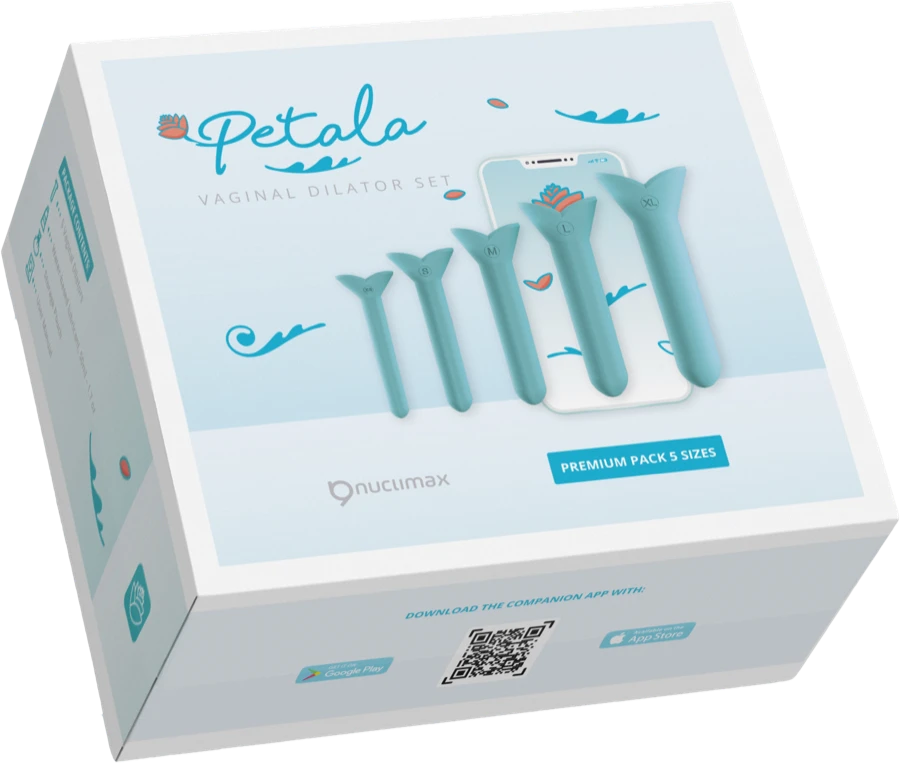
The Petala companion app (included with the Petala 5-Pack) allows you to:
- Log each session — dilator size, duration, comfort level, and notes
- View progress over time — charts and summaries that show your trajectory across weeks and months
- Set reminders — consistent practice is the most important factor in your timeline, and gentle nudges help maintain routine
- Access guided exercises — breathing, relaxation, and mindfulness content designed for before and during sessions
Frequently Asked Questions
How long does dilator therapy take for vaginismus specifically? For vaginismus, some women notice meaningful change within weeks while others need several months. There is no single research-backed timeline that applies to everyone. Primary vaginismus often takes longer than secondary vaginismus, but severity, anxiety, prior treatments, and professional support all matter.
Can I speed up the process by practising more often? Up to a point. More frequency only helps if sessions stay comfortable. If daily practice leaves you sore, anxious, or avoidant, it is not speeding you up. A sustainable rhythm matters more than chasing an aggressive schedule.
What if I’ve been doing dilator therapy for months with no progress? First, review the basics: Are you using adequate lubricant? Are you practising consistently? Are you truly pain-free at your current size before attempting the next? If the fundamentals are in place and you’ve been stuck for more than 6 weeks, consult a pelvic floor physiotherapist. There may be a physical factor (such as a specific muscle trigger point or scar tissue) or psychological factor that needs targeted attention.
Is it normal to go backwards — needing to return to a smaller size? Absolutely. Setbacks are a normal part of the process, not a sign of failure. Stress, illness, hormonal changes, time away from practice, or emotional upheaval can all temporarily increase pelvic floor tension. Return to the last comfortable size, rebuild from there, and you’ll typically regain lost ground faster than the first time.
Do I need to continue dilator therapy forever? Not typically. Once you’ve reached your goal and maintained it consistently for several weeks, most women can reduce to occasional maintenance sessions (once or twice a week, or even less frequently). Some women find they no longer need dilators at all once comfortable penetration has been established and maintained. Your pelvic floor physiotherapist can guide you on a maintenance schedule.
Conclusion
Dilator therapy is a journey, not a sprint. What the evidence supports is caution about one-size-fits-all promises: some women move quickly, others need longer, and progress is usually measured in weeks or months rather than days. The most important factors within your control are consistency, patience, and self-compassion. Progress is rarely linear, plateaus are normal, and every session — even the difficult ones — is part of the process.
When you’re ready to begin or continue your journey, the Petala 5-Pack provides five graduated medical-grade silicone dilators and a companion app with session tracking, guided exercises, and progress visualisation — everything you need to move forward at your own pace.
References
[1] Melnik, T., et al. (2012). “Interventions for vaginismus.” Cochrane Database of Systematic Reviews, Issue 12, CD001760.
[2] Chalmers, K.J. (2024). “Clinical assessment and management of vaginismus.” Australian Journal of General Practice, 53(1-2), 37–41.
[3] Pacik, P.T., & Geletta, S. (2017). “Vaginismus treatment: Clinical trials follow up 241 patients.” Sexual Medicine, 5(2), e114–e123.
[4] Zulfikaroglu, E. (2026). “Vaginismus treatment: a systematic review and meta-analysis of contemporary therapeutic approaches.” The Journal of Sexual Medicine, 23(1), qdaf295.
[5] Memorial Sloan Kettering Cancer Center. (2025). “How To Use a Vaginal Dilator.”
Ready to start your journey to pain-free intimacy?
Shop Petala 5-Pack