
Last updated:
Vaginal Dilator Size Guide: How to Choose, Progress, and Avoid Common Mistakes
A comprehensive vaginal dilator size guide covering how to choose your starting size, when to progress, size chart comparisons, and common mistakes to avoid during dilator therapy.

Choosing the right dilator size is one of the most important decisions you’ll make at the start of your therapy journey — and one of the most common sources of confusion. Too large, and you risk pain and setbacks. Too small, and progress can stall before it begins. This guide walks you through everything you need to know: how to select your starting size, when and how to progress, what the research says, and the mistakes that trip most people up.
Medical disclaimer: This article is for educational purposes only and does not constitute medical advice. Always consult a qualified healthcare professional — such as a pelvic floor physiotherapist or gynaecologist — before beginning or adjusting a dilator therapy programme.
Why Does Dilator Size Matter?
Dilator therapy works on the principle of graduated exposure: gently and progressively stretching vaginal tissue and retraining pelvic floor muscles to relax rather than contract. The size you start with, and the pace at which you advance, directly affects whether the experience feels safe and productive — or painful and discouraging.
Progressive vaginal dilation is widely used within multimodal care plans for vaginismus and other penetration difficulties, but the research does not support a single universal success rate or sizing schedule [1][3]. The key word is progressive — forcing a size that your body isn’t ready for undermines the entire process.
How Are Vaginal Dilators Sized?
Most dilator sets use a numbered system (Size 1 through Size 5 or Size 6), with each size increasing in both diameter and length. The critical measurement is diameter — this determines how much stretch the vaginal opening and canal experience.
Typical Dilator Size Ranges
| Size | Approximate Diameter | Approximate Length | Common Use |
|---|---|---|---|
| Size 1 (XS) | 15–18 mm | 70–80 mm | Absolute beginners, severe vaginismus |
| Size 2 (S) | 20–23 mm | 80–95 mm | Early therapy, building confidence |
| Size 3 (M) | 25–28 mm | 95–110 mm | Mid-range progression |
| Size 4 (L) | 30–33 mm | 110–125 mm | Advanced therapy |
| Size 5 (XL) | 35–38 mm | 125–140 mm | Final stage, approximating average penetration |
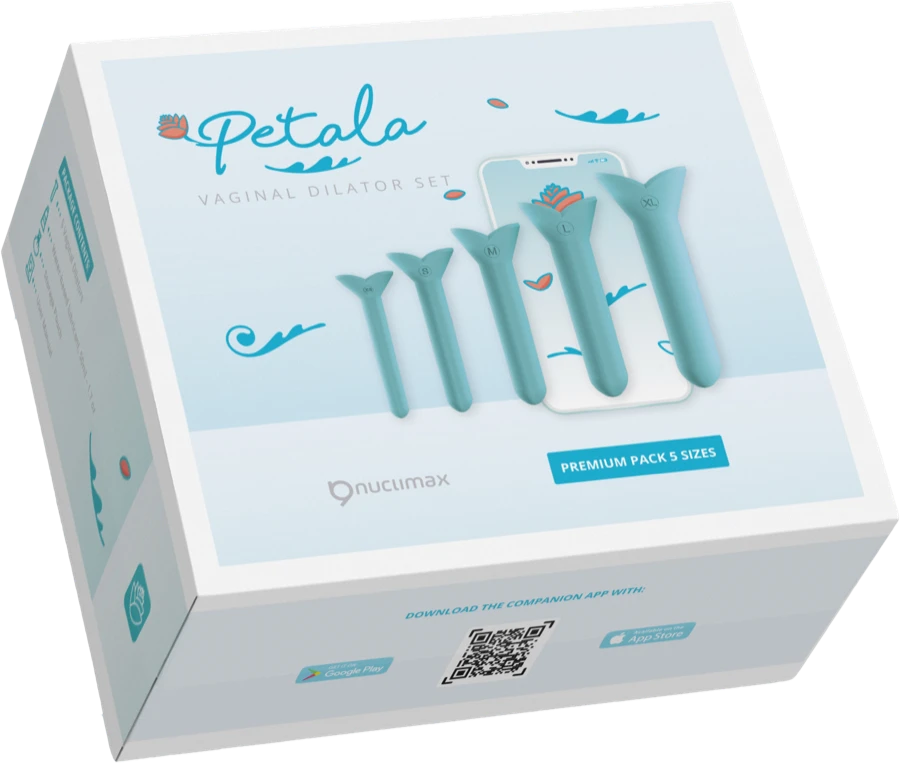
Note that sizing varies between brands. The Petala 5-Pack covers this full therapeutic range in a single kit, with five graduated sizes designed to take you from first session to full confidence.
How Do You Choose the Right Starting Size?
This is the question that causes the most anxiety — and the answer is simpler than you might think.
The Comfort Rule
Your starting dilator should be the largest size you can insert without pain. Not discomfort-free (some mild sensation of pressure is normal), but genuinely pain-free. If insertion causes sharp, burning, or stinging pain, the dilator is too large for your current starting point.
Self-Assessment Method
If you don’t have access to a pelvic floor physiotherapist for an initial assessment, you can perform a simple self-check:
- Wash your hands and find a private, comfortable space
- Apply water-based lubricant to one finger
- Gently insert one finger — if this is comfortable, you can likely start with Size 1 or Size 2
- Try two fingers side by side — if this is comfortable without pain, you may be ready for Size 2 or Size 3
- Note any areas of tightness or tenderness — these are useful observations for your therapist
Professional Assessment
Ideally, a pelvic floor physiotherapist should assess your baseline before you begin. They can evaluate muscle tone, identify trigger points, and recommend a precise starting size. This is particularly important if you have a diagnosed condition like vaginismus, vulvodynia, or post-surgical scarring.
What Does a Good Progression Strategy Look Like?
There is no universal timeline for advancing through dilator sizes. Your body sets the pace. However, there are clear principles that guide safe, effective progression.
Signs You’re Ready to Move Up
You’re likely ready for the next size when:
- You can insert the current dilator without pain and with only mild pressure sensation
- You can hold the dilator comfortably for 10–15 minutes without significant discomfort
- You feel emotionally calm during sessions — no significant anxiety or bracing
- You’ve used the current size comfortably across several consistent sessions (though some sizes may take longer)
No Universal Calendar
There is no research-backed rule that says you must spend a fixed number of days or weeks at each size. In practical clinical guidance, progression is based on comfort: when one size can be inserted fully without discomfort, you can begin working with the next size [2].
Half-Size Progression
If the jump between two consecutive sizes feels too large, you can bridge the gap:
- Insert the smaller size first, hold for 5 minutes, then attempt the larger size
- Angle the larger dilator slightly during insertion — partial depth counts as progress
- Use the Petala companion app to track partial insertions and build confidence gradually
What Are the Most Common Sizing Mistakes?
Even with the best intentions, certain mistakes can slow your progress or cause setbacks. Here are the ones pelvic floor physiotherapists see most often.
Starting Too Large
The most common mistake. Motivated by a desire to progress quickly, many women choose a starting size that’s already uncomfortable. This creates a negative association with therapy — your brain learns that dilators mean pain, and your pelvic floor tightens further in response.
The fix: Always err on the side of too small. A few extra days at a smaller size costs nothing; a painful first experience can set you back weeks.
Rushing Between Sizes
Progress is not a race. Moving to the next size before the current one is truly comfortable is the second most common error. The pelvic floor needs time to not only stretch but to learn a new resting state at each level.
The fix: Use objective criteria (pain-free insertion, 10–15 minutes comfortable hold, calm emotional state) rather than a calendar to decide when to advance.
Skipping Sizes
Some women attempt to skip a size entirely — jumping from Size 2 to Size 4, for example. This rarely works and often causes pain, muscle guarding, and loss of confidence.
The fix: Every size in a graduated set exists for a reason. Trust the progression.
Neglecting Lubricant
Insufficient lubricant increases friction, which the body interprets as a threat — triggering the very muscle tension you’re trying to overcome. This is especially relevant when attempting a new, larger size. For detailed guidance on choosing the right lubricant, see our lubricant guide for dilators.
The fix: Apply lubricant generously to both the dilator and the vaginal opening before every session. Reapply during the session if needed.
Ignoring Emotional Readiness
Your body and mind are connected. If you’re stressed, anxious, exhausted, or distracted, your pelvic floor will reflect that. Attempting a size-up on a bad day often leads to a frustrating session.
The fix: Check in with yourself emotionally before each session. If today isn’t the day, that’s perfectly fine. Consistency matters more than any single session.
How Does Petala Compare to Other Dilator Sets?
Not all dilator kits cover the same size range or offer the same size increments. Here’s how the Petala 5-Pack compares to other popular options.
| Feature | Petala 5-Pack | Brand B (4-Pack) | Brand C (6-Pack) |
|---|---|---|---|
| Number of sizes | 5 | 4 | 6 |
| Full therapeutic range | Yes | Partial — smallest size often too large for severe vaginismus | Yes |
| Material | Medical-grade silicone | Medical-grade silicone | Mixed (some plastic) |
| Companion app | Yes | No | No |
| Graduated increments | Even progression | Larger jumps between sizes | Smaller jumps but inconsistent material |
For a detailed head-to-head comparison with one of the most popular alternatives, see our Petala vs Intimate Rose review.
How Do Pelvic Floor Exercises Support Sizing Progress?
Dilator therapy doesn’t happen in isolation. Strengthening and — more importantly — learning to relax your pelvic floor muscles accelerates your ability to progress through sizes safely. Targeted pelvic floor exercises complement dilator therapy by teaching you conscious control over muscles that normally operate involuntarily.
Key exercises include:
- Diaphragmatic breathing — engages the pelvic floor’s natural relaxation reflex
- Reverse Kegels — practise consciously releasing and lengthening pelvic floor muscles
- Progressive muscle relaxation — systematically tensing and releasing muscle groups to reduce overall body tension
When Should You Seek Professional Help with Sizing?
While self-guided dilator therapy is effective for many women, certain situations call for professional input:
- You cannot comfortably insert even the smallest dilator after several attempts
- You experience sharp or worsening pain despite using the smallest size with adequate lubricant
- You’ve been stuck at the same size for more than 4–6 weeks without progress
- You have a known condition such as vulvodynia, endometriosis, or post-radiation changes
- You feel significant anxiety or distress that makes it difficult to begin or continue sessions
A pelvic floor physiotherapist can provide hands-on assessment, manual therapy, and personalised guidance. For more on recognising when professional support is needed, see our article on when to see a doctor.
Frequently Asked Questions
What size dilator should I start with if I have vaginismus? Most women with vaginismus begin with the smallest available size (Size 1, approximately 15–18 mm diameter). If even this feels too large, a pelvic floor physiotherapist can work with you using manual techniques before introducing a dilator. The goal is always to start where you are — not where you think you should be.
How long should I stay at each dilator size? There is no fixed timeline. Many women spend several sessions, and sometimes a couple of weeks, at each size before moving on. Some transitions take longer than others — particularly when the diameter jump feels more noticeable. Let comfort, not the calendar, guide your decisions.
Can I use dilators during my period? Yes, there is no medical reason to avoid dilator therapy during menstruation. Some women find that the natural increase in cervical mucus during this time actually makes insertion easier. However, if you’re uncomfortable or experience increased sensitivity, it is perfectly fine to take a break.
What if the jump between two sizes feels too big? This is common, particularly between mid-range sizes. Try inserting the smaller size first to warm up, then gently attempt partial insertion of the larger size. You can also angle the larger dilator slightly rather than aiming for full insertion immediately. Over several sessions, you’ll find the transition becomes easier.
Should I measure myself to determine my starting size? Self-measurement is not necessary and can actually increase anxiety. The finger-based self-assessment described above, or — ideally — a professional evaluation by a pelvic floor physiotherapist, gives you all the information you need to choose an appropriate starting size.
Conclusion
Choosing the right dilator size is not about getting it perfect on day one — it’s about starting where your body feels safe and progressing at a pace that builds confidence rather than fear. Every woman’s journey is different, and there is no “behind schedule.” Trust the process, listen to your body, and celebrate every step forward.
When you’re ready to begin, the Petala 5-Pack provides five graduated medical-grade silicone dilators covering the full therapeutic range, along with a companion app to track your sessions and guide your progression — everything you need in one kit.
References
[1] Chalmers, K.J. (2024). “Clinical assessment and management of vaginismus.” Australian Journal of General Practice, 53(1-2), 37–41.
[2] Memorial Sloan Kettering Cancer Center. (2025). “How To Use a Vaginal Dilator.”
[3] Melnik, T., Hawton, K., & McGuire, H. (2012). “Interventions for vaginismus.” Cochrane Database of Systematic Reviews, (12), CD001760.
Ready to start your journey to pain-free intimacy?
Shop Petala 5-Pack